My Experience attending a gig at Cardiff’s Utilita Arena part two – attending the gig.

This is a follow on to my other post, so if you haven’t seen part one I would recommend reading that before reading this one so it all makes sense.

On the day of the gig, I made sure I got up at a reasonable time, I didn’t set my alarm ridiculously early meaning that I could rest, but I also didn’t do it overly late to make sure I had enough time to get myself ready through the day.

I made sure I had a sensible meal, something I knew would give me energy but was less likely to cause severe stomach pain, I chose gluten free pasta, bacon, cheese and a little melted butter. We ate around 3pm to make sure there was plenty of time for the food to settle before I needed to get ready and then leave.

I started getting ready around 4 pm, I had already refreshed my curtly hair earlier in the day, so I slowly did my make up and then got dressed and did my hair with a simple clip. I chose comfortable clothing to maximise my comfort that the gig – simple black leggings and a merch t-shirt.

When it was time to go over to the gig, I took any extra accessories that weren’t needed off my rollator to make things easier for security, I put my empty plastic water bottle in the basket of my rollator and made sure all the meds I needed were in my hand bag in the original boxes with the pharmacy label. I also took some gluten free snacks which I had pre-agreed with the venue, which included some sweets incase I needed some quick sugar, and some gluten free cheddar crackers (a bit like mini cheddars).

We set off about half an hour before doors were due to open, wanting to make sure we weren’t getting inside too late, while making sure we could take our time walking there. We knew we had seats, so we both wore proper coats, and I had gloves and a scarf. I had some small lights on my rollator, so I turned these on to make myself more visible in the dark, and so that I could see any small obstacles on the pavement.

When we got to the arena, we asked a security worker where the accessible entrance was, and he walked us around the side of the arena to where the accessible door and ramp were. When doors opened, we went inside via the ramp and joined the line for security. When it was our turn, we told them of the oxygen tanks, and they went to get some tags to put on the bags.

While we were waiting, the member of staff that I had been talking to via email came looking for us, to make sure that I got through security with everything I needed, and found my seat. We had green “security approved” tags placed on the two oxygen bags so that everyone knew they were allowed into the main part of the arena, and then we were shown into the main part of the arena where the gig would take place.
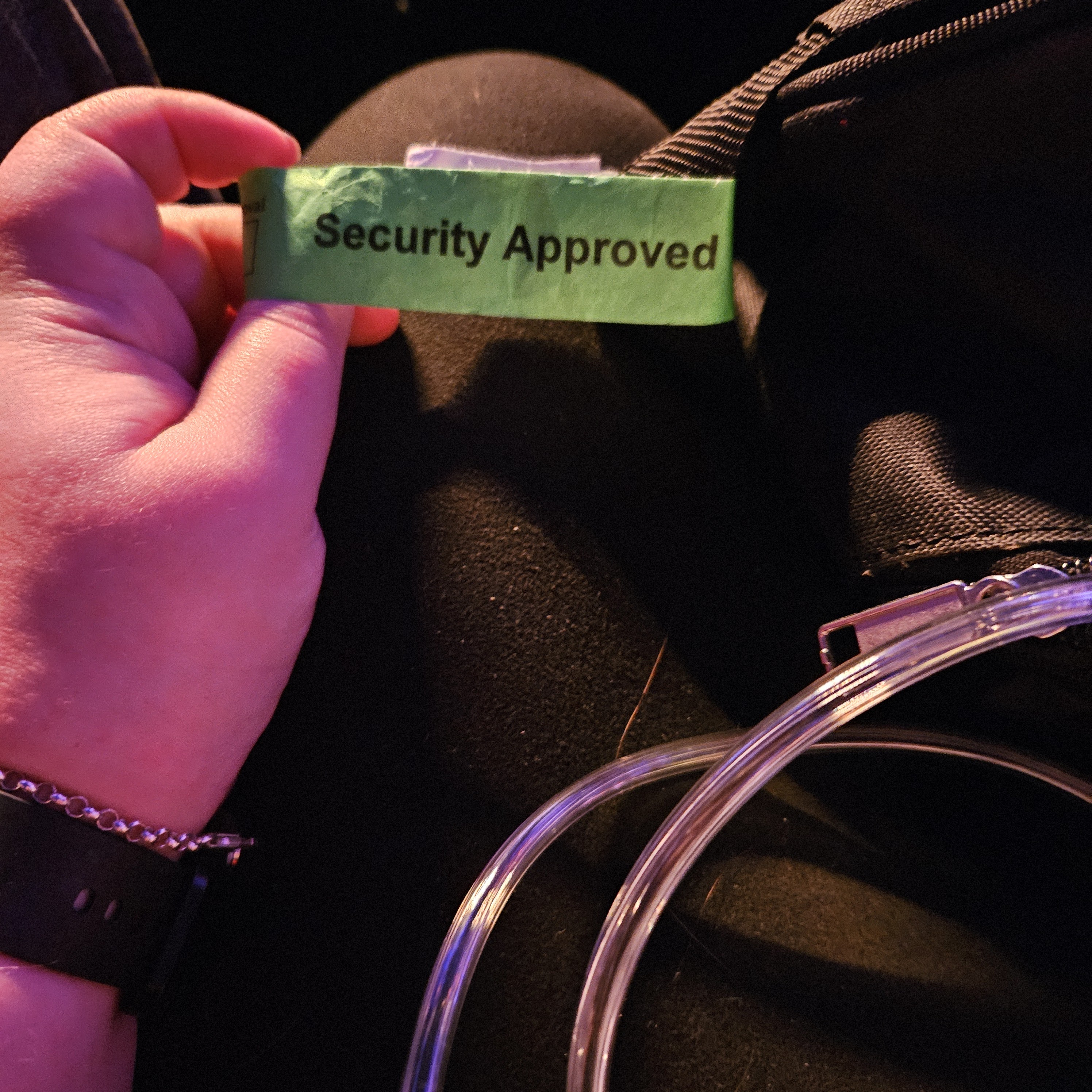
Tag attached by arena security to show my oxygen tanks were allowed into the main arena

We were taken to the steward who would look after our section of seating, and then the member of staff who found us in the lobby took me to see where my rollator would be stored. They placed it beside one of the coffee bars, under the tiered seating and hidden by a curtain. This meant it was kept an eye on all night, and I could relax knowing it wouldn’t be tampered with and that I would be able to get to it easily if I needed to during the gig or in case of an emergency. She helped me up the small amount of steps towards my seat, and told me that if I wanted to move around when the lights were out to wait for her to help me down the steps so that I didn’t trip.

We then found our seats and settled in. After a while the arena started filling in, and I decided to go to the bathroom before the gig started. I had already been shown where the accessible bathrooms were, and how to get to them. On my way back I had a chat to the steward, Nicola, to ask if there was anything we could do if people were stood infront of us for a long time during the gig. At first there was a little confusion, as she thought I meant the people in the standing area! When I explained that I meant the people who were supposed to be sat down, she said that if they wanted to stand they would be directed to the standing area. I understand that people want to dance at gigs, and wouldn’t have minded people standing for a song or two, but I heard people saying they planned to stand for the entire gig, and this was concerning as I knew I wouldn’t be able to stand, and there were other disabled people around us who would have had the same issue.

A photo of the script as seen from our seats

Throughout the gig, the staff were really good at enforcing the no standing/go to the floor rules, and consistently reminded people that they needed to sit down or go to the standing area, as there were people in the section that couldnt stand. In fairness to the people who were infront of me, they did move to the floor, and were very understanding, even asking their children not to stand infront of me or block my view.

At the end of the gig, I was taken to my rollator, and we were asked about our experience. I waited on my rollator while my partner got me my merch, and I refilled the water bottle for the walk back to the apartment. We asked a steward how to get back to the ramp, and he offered to walk with us, but once he gave us directions we felt pretty confident so we made our way towards the ramped exit. As we were approaching another steward saw us and walked us the rest of the way, making sure we had clear passage to the ramp and exit.

We had an amazing time at the gig, and we are so glad we went. For a while it felt like something we would never do again, partly because of Covid, but also because my mobility and general health have deteriorated so much in the past 4 years. We didn’t know if my cluster headaches would cope with the strobe lighting, or if my hips would allow me to sit on the seating.

I was very fortunate and although I did get a small niggle in my head I was able to keep it at bay with a small amount of Oxygen, and the strobe lighting really didn’t impact me the way we thought they would.

I am very grateful we got this experience, and I am so excited to know that this is something I can still enjoy.

My experience attending a gig at Cardiff’s Utilita Arena part one – preperation.

I have always loved music, I grew up surrounded by it, I was very fortunate to go to schools that heavily encouraged it and have parents who introduced me to so much great music while encouraging me to pursue my own interests in it. Before the pandemic, I attended quite a few gigs with my fiancé, including George Ezra, BBC big weekend Swansea, Tom Walker and multiple gigs with The Script. During the hight of the pandemic we started to wonder if I would ever get to go to a gig again. However, on Monday 18 November 2024 I finally got back to something I deeply love – singing my heart out with my fiancé by my side, surrounded by people who are united by music at a gig performed by my favourite band. I am going to share my experience from booking the gig to attending and everything in between.

For those that aren’t aware, during the covid Pandemic I entered shielding. This was the government programme in the UK aimed at trying to protect those deemed most vulnerable to severe complications if they contracted Covid, especially before they knew wha treatments were effective. While official shielding actually ended quite a while ago, my doctors have advised I continue to take a lot of precautions and until June 2023 we still weren’t really having people in the house, and I wasn’t going out very much at all, but something happened in my personal life that forced me out of shielding, and I started to think about how to balance keeping safe with having some sort of quality of life.

The last thing I actually did before entering shielding was attend a gig by The Script in Cardiff, so when they announced their new album, Satellites, earlier this year with an arena tour to go with it, I strongly felt like it would be the perfect way to get my feet wet and try getting back into society. We were nervous though, and we knew that a lot had changed since the last gig we attended. We knew I wouldn’t be able to stand for the gig this time, and that I would have to take my rollator and portable oxygen plus my sumatriptan injections.

Before we booked the tickets, I emailed the Utilita arena to ask if bringing in these items would be OK, and to see if I would be OK to book in the general seated area if the access tickets were sold out. They came back to me really quickly and told me as long as I had prescriptions for medicines and my oxygen it would be fine, and they let me know that I could book anywhere in the venue I wanted, just to let them know where I would be so they could make sure I was looked after.

The morning of the ticket sale came, and the accessible tickets ran out pretty quickly, so we booked some standard seated tickets, and I emailed the venue to let them know. They advised me that they would be able to store the rollator for me so it wasn’t left unattended or creating a hazard for anyone. They also told me that there would be a medical room I could use if I needed to inject my sumatriptan during the gig, and that if I needed a private room at all they would be able to organise this for me.

Once the basics were sorted out, I emailed to let them know I would be able to get all the paperwork they needed, and asked them if I would be allowed to take in a bottle or a drink. Previously we had stood at the gigs in this location, and they usually handed out water, particularly if you were near the front, but I was aware that this may not be the case in the seated area, as it isn’t as hot there. I let them know about my coeliac disease and how I may not be able to consume the drinks sold in the venue, as there may be contamination risks, or they may contain barley. Again they responded really quickly, and they let me know that I could take in an empty plastic bottle for water which I could fill for free at their drinking water fountain, and that I could even take in a small amount of gluten free snacks.

As we got closer to the gig, I made sure I contacted my respiratory nurse for a copy of my oxygen prescription. I also contacted the oxygen delivery company to let them know I would be staying away from home for a few days incase I needed to get an emergency delivery while there. I also ordered something called a tube clip. They are usually used by people with feeding tubes to hold the tubing out of the way and support it so that if it gets tugged it doesn’t tug on where the tube enters the body. Having seen how they worked, I ordered one from Miana at Tubie Express, and planned to use it to hold my oxygen tubing out of the way while at the gig, so that it would move with me and not be a trip hazard for anyone else. I did end up using it, and it worked perfectly.

About a month before the gig, I found an accessible taxi company from south Wales who had a wheelchair accessible taxi available, and booked with them. This meant we knew I would be able to take my rollator or even my wheelchair, and we wouldn’t have to stress about taxis or buses.

We travelled to Cardiff two days before the gig. I made sure I had my medications in their original boxes with the pharmacy labels visible, I also made sure that I packed my loop earplugs incase I needed them in the gig, and my sun glasses incase the strobe lighting caused an issue. I double checked that the oxygen company had the full address, and I made sure that I rested appropriately before the trip.

Using the accessible taxi definitely made a huge difference, and made this trip much less painful and stressful so it is definitely something I would recommend if you have the option of doing it.

What I wish I knew when I first became unwell

They say hindsight is a wonderful thing, and this definitely something I think applies to life with chronic illnesses, so I thought I would talk about some of the things I wish I had known when I first became unwell.

1 – Doctors can be wrong

Yes, you read that correctly, doctors can indeed be wrong! Believe it or not, doctors are just human like the rest of us, so they can definitely make mistakes and be wrong about things, including diagnoses. There are many occasions looking back where I wish that I had spoken up and said “no, that doesn’t feel/sound right” and it would have saved a lot of pain and unnecessary testing. I am much better with this these days and always make sure I understand what a doctor is asking me to do and WHY they want me to do it. Taking this approach has saved me from some very serious complications in the past and is something I definitely recommend.

2 – Clear tests doesn’t mean nothing is wrong

I spent a long time thinking my symptoms weren’t serious or weren’t worth “bothering” the doctors with because blood tests and X-rays were coming back clear. No matter how bad the pain got, the tests would be normal and I would be sent away with painkillers and told things would sort themselves out. After suffering for a long time I finally got the courage to ask for an MRI, which gave us the first real evidence that there was something more serious going on. Even now, I don’t have any blood test results that definitively prove my inflammatory arthritis, but I have a diagnosis, because my symptoms were not going away and I respond well to steroids. Tests can be useful, they can give an indication of our overall well being, but they are not the best all and end all. If you had tests come back clear despite ongoing symptoms, keep fighting, don’t be put off until you have an answer you are satisfied with.

3 It’s ok to say no to a doctor

Growing up we are taught to respect doctors, they are authority figures, we go to them for advice and as such we should listen to them and take their advice, but, as a long term and frequent patient I have had to learn to be able to say no to them. One key example is when I went to see an endocrinologist for advice about my thinning bones and high calcium. He prescribed me a medication that I wasn’t totally comfortable taking, so instead of just taking it , I went to someone I trusted, my IBD nurse and asked her advice. At the time I was undergoing brace treatment ready for surgery to correct the position of my jaw, being aware of this my IBD nurse advised me to speak to my orthodontist before taking any of the medication. When I spoke to the orthodontist she told me that if I took even one of those tablets they would have had to take my braces off there and then and cancelled my surgery. It turns out the medication was known to cause necrosis in the jaw bone if the jaw was moved or manipulated in any way and there was a decent chance of it happening to me if we continued with treatment. There was no blood test able to detect this medication in the blood, and the half life (amount of time it stays in the body) was unknown, so they wouldn’t be able to tell if the medication was still in my blood stream, meaning that they wouldn’t have even been able to do the surgery at a later date, it would have been cancelled completely. Me saying no to that endocrinologist saved my jaw and possibly my life. If a doctor ever tells you to do something that you know is incorrect, or that you just have a bad feeling about it’s totally OK to just say no and/ or request an opinion from another health care provider.

4 It’s OK not to be OK

For a long time I would bottle things up and if someone asked how I was I would always say I was fine. My logic was that people didn’t need me to keep saying I was sick, that it would just be complaining and that they didn’t need to hear that. For a long time I thought “They know I’m sick, they know I won’t get better, no need to keep saying I’m sick”. Unfortunately that meant that I was keeping my suffering to myself, I was saying I was OK when I really deeply wasn’t, I didn’t want to burden people, but in trying to protect everyone else I was making myself suffer more than necessary. You don’t have to dwell on your illness if you don’t want to, and it doesn’t have to come up in every conversation if you would rather it didn’t, but keeping it to yourself may not be the best thing for you. If you have family and/or friends that you can trust then let them in, let them know you’re not ok, even if that’s just telling them how much pain you’re in, its ok if you aren’t OK and you shouldn’t have to hide it from the people who are supposed to care about you.

5 – Its ok to put your needs first

This is something I find particularly tough. I have always been a listener, an agony aunt if you like, I have always wanted to help people as much as I can and would often put my own needs aside in order to be there for others. One of the things I hate most about my chronic illnesses is that I know it causes other people pain and stress, I know its hard for people who love me to see me struggle, I know its stressful for them to have to help me with things that most people would be able to do for themselves. I would often down play how much I struggled, or push myself beyond my means to try to help someone with a difficult situation and it took me a long time to realise that I was actually harming both myself and them by putting myself last. I have learnt over time that sometimes I have to be a little bit selfish and take care of my own needs, both emotionally and physically, before I can be a good friend or confidant to others. I have learnt that even simple things, like putting my phone down by a certain time each night, keeping the do not disturb turned on during bad days, having messages from new people on my chronic illness account go to requests instead of straight to my inbox all help. I have learnt to say “no”. I have learnt to say ” I cant deal with this right now, so I will talk with you later” . All these things seem small, but they are ways of enforcing healthy boundaries and ensuring I rest when I need to, I eat when I need to and I limit the amount of stress on particularly difficult days. There are many ways in which you can prioritise your own needs, so whatever works for you is OK, don’t be afraid to put those boundaries in place and stick to them.

6 – Embrace the things that bring you joy, no matter how small

This may seem like an obvious one, but I think its something we could all use a reminder of now and again. When dealing with the constant pain and stress of chronic illnesses and disabilities, life can become an endless routine of medications, appointments, managing hydration and nutrition and endless phone calls. Being chronically ill really is a full time job, and it’s one we don’t get a break from. We cant clock off at 5 on a Friday and forget about it until 9 am Monday. We can’t hire a baby sitter or ask someone else to take over for a few hours. With this in mind, its important that we take any opportunity for even a tiny piece of joy, no matter what that is. Want a chocolate chip cookie? Then have one! Love reading? Take an hour a day and read whatever your heart desires. Love music? Listen to a song every morning before you get out of bed or while you’re doing your treatments. For me, I love being creative, I play the flute, I sketch and paint and I have just started to work on my first ever patchwork quilt. I try to make sure that the majority of days I get to do at least one thing related to one of these things, whether that’s listening to some flute music, getting my flute out and playing or just watching a 10 minute video on a water colour technique that I want to try one day. It helps me feel human, it reminds me that I deserve joy and happiness and it gives me at least a small part of my day that isn’t dedicated to self advocacy, medications or managing symptoms and that’s really powerful.

7 – It’s ok not to use unsolicited advice

This is one I struggled with a lot in the early days. Unsolicited advice is something that everyone with a chronic illness has come across in one way or another. It’s usually well meaning and often comes from people who actually think they are being helpful, so it can be hard to say no to. In some cases, ignoring unsolicited advice can even make us feel guilty, we know the person was just trying to help so we feel bad when we don’t do what they say. The truth is though that usually we have already received good advice from people who are actually qualified to give it – doctors and other patients with similar experiences. Advice from family and friends can of course be helpful if they truly understand our health needs and know something that we don’t or have experiences that allow them to see things in a similar way but when advice is being given without being asked for its a different story. If you aren’t asking for advice then the chances are you already know what you need to do, or you know that at this point there isn’t anything you can do to make the situation better. People often don’t like being told this, so even if you have explained that you’re doing all you can, many will still try and offer advice, and its totally OK to not take it, it’s even ok to tell the person that you don’t need advice right now, and would appreciate a listening ear or some practical help instead where appropriate.

8 – You will make mistakes when it comes to your health and that’s OK

No one is perfect. We all make mistakes sometimes, whether that’s at school, work or home, and health care is no different. It might be something like accidentally ingesting a food that you are allergic to even though you have taken all the precautions, or missing a dose of a medication or forgetting to go to an appointment. Things happen. We are not robots. I have been dealing with chronic illnesses and chronic pain for 19 years. I have had coeliac disease since I was 14. I have definitely forgotten to take a dose of meds or two in that time. I have also eaten food that contained gluten, I have even been served a food that contained gluten by a family member. I would never do these things on purpose, and each time a mistake happens I do everything in my power to learn from it and make sure that specific mistake is not repeated, but I don’t spend weeks or months berating myself for it either. I am honest with my family and my medical teams when something happens, and I do everything they advise to correct the mistake, but I don’t hold a grudge against myself or whoever caused the mistake. I acknowledge it, I take steps to prevent a repeat and I move on. No one can be 100% perfect 100% of the time and that’s OK.

9 – Its not your job to inspire people

Something I come across a lot online is the desire of able-bodied/ healthy people to be inspired by disabled people. People constantly tell me I’m amazing for simply existing and honestly its tiring. I don’t want to be put on a pedestal for simply getting out of bed and going to the shops, or for having a shower and getting dressed. A common one for me is being stared at and receiving sympathetic and knowing smiles when going about my day with my rollator or my wheelchair, this is especially true if I happen to have my oxygen on at the same time. People will often bring attention to the mobility aid, making jokes or comments related to it, even asking me “what’s wrong” or “why I need it”. All I want to do is go about my day without any extra fan fare or attention, I just want to exist in society like everyone else. I want to get to my doctors appointment without feeling like a tourist attraction or go to a cafe and have a cup of tea without it feeling like the event of the year. I know the majority of people are not trying to make me uncomfortable and are genuinely happy or curious to see someone they perceive as different, but I am just a 30 something year old woman that want’s to live my life and enjoy the small amount of freedom I still have. It is not my job to be inspiring or make other people feel better when I’m just trying to buy some milk.

10 – Quality of life is just as important as quantity

Having a long life is something many of us want and when diagnosed with serious illnesses it’s totally normal to worry about the impact that may have on the longevity of our lives, but there isn’t much importance placed on the quality of that life. When I was first diagnosed, the focus was mostly on avoiding emergencies such as a perforated bowel, keeping my body ticking over until we could get to my planned surgery and trying to avoid any life threatening complications. There was very little mention or focus on quality of life. Aside from some family members, no one really asked me about my pain levels or how they were impacting my ability to function, no one wanted to hear about the long sleepless nights spent wondering what would happen next, no one wanted to listen to me complain about how much of a chore eating had become, they didn’t want to hear about how horrible the steroids were making me feel. The doctors just wanted to keep me safe. The priority was trying to avoid serious complications and everything else was secondary. In the beginning this made sense, the doctors I was under at the time thought that once i had my surgery, i would be pain free and able to lead a normal life for at least a few years, so to them the pain was temporary and as long as I got through the surgery and out the other side things would be golden. What no one expected or prepared for was the idea that the surgery wouldn’t fix everything, the idea that the crohns would come back relatively quickly or that I would end up diagnosed with several other conditions. It took a long time to realise that I was going to be sick/in pain for the majority of my time. Once this realisation came, I realised that I would need ways to handle my symptoms at least enough to give me some sort of quality of life. One of my biggest and most hated symptoms is nausea, it always surprises people when I say that my anti sickness meds are the ones I would hate to be without the most, the nausea is all consuming, it creeps into every fibre of my being and makes it hard to do anything other than lay in bed all day, Getting it under control took a lot of trial and error, I take two powerful anti sickness medicines every day without fail, and I cannot miss them. Controlling my nausea means I can eat, drink, sleep, talk and spend time around other people without being constantly paranoid about loosing my lunch. The other big thing is of course pain control. I will likely never be pain free, but having decent pain relief has kept me out of hospital many times, it means i can manage flare ups at home, I can eat, I can do light exercise. I can even do fun things like go to the cinema or the occasional gig. Controlling the underlying illnesses may keep me alive, but controlling the symptoms allows me to live, and that is SO important and precious, and when it comes down to it, I would never be able to live without quality of life.

Why sentences that start with “at least” are generally unhelpful

We’ve all been there, someone is having a difficult time or they tell you about something hard in their lives and you really want to comfort them. It can be hard to know what to say when someone is going through a hard time, but sentences that start with “at least” are often the opposite of comforting apart from in a few very specific contexts.

As someone who has been dealing with chronic illnesses and pain for a long time and someone who has been very open with my journey since adulthood, I have heard a lot of “at least”. They have included

  • At least its not “insert illness perceived to be worse”
  • At least you have a partner
  • At least you have money (I don’t but that’s not the point)
  • At least you get to stay home all the time
  • At least you don’t have to work
  • At least you are young
  • At least you can do X activity

A lot of the time people mean well when they say these things, but sometimes people genuinely think you’re lucky because you don’t “have” to work and they do, or they think that your condition isn’t as bad as theirs, or that there are other conditions worse than what you have.

I am going to try to debunk some of these and explain why even if they were true, they still wouldn’t be helpful

At least its not “insert illness perceived to be worse”

There are a few reasons this isn’t a great thing to say, for a start its really dismissive, illness, pain and suffering are all relative, someone could be having the worst pain of their lives, it doesn’t matter if you think you have been through worse, if its the hardest thing they have been through, then its the hardest thing for them and that is valid. Even if they have been through worse in the past, they are allowed to find “easier” things just as tough to deal with.

Secondly, illnesses and suffering isn’t a competition, everyone is allowed to struggle , everyone has their own battles and they are entitled to support, no matter what other people are dealing with.

Thirdly, diagnosis alone does not dictate how much pain someone is in or how sick they are, or what other circumstances they have in their lives that could make things difficult. There are people out there with diagnoses that are perceived to be “worse” than mine who are actually much healthier overall and have a better quality of life. I also know of people who have diagnoses which are perceived to be less serious than mine who happen to be much sicker than me. The point is, the name of the illness alone does not tell us how sick someone is. Regardless, diagnosis does not dictate how much someone is going to suffer, it doesn’t tell people how much pain you are in, how much you can eat, how much medication you need to function, how difficult things are in their home lives, how difficult accessing care is or anything else that could impact their situation.

At least you have a partner

This is something I get a lot, usually from healthy people who just happen to be single. Don’t get me wrong, I absolutely love my fiance and I am very blessed to have someone in my life who loves me and who actually means the vows “In sickness and in health”.

However, the people who say this to me know nothing about my relationship or if its healthy or not, they just think I am lucky to be in a relationship and some of them even behave as if being in a relationship somehow makes being sick OK or not as life changing.

I am very, very blessed that I have someone who is supportive, kind and compassionate, but, maintaining a relationship when you’re really sick isn’t easy. Relationships in general need a lot of patience, understanding and hard work from both sides. When one of you is severely unwell, you both have to work even harder to keep communication open, to not get ratty with each other when you’re both running on no sleep. It is hard for me sometimes not to get short tempered when my pain is through the roof and I have not slept more than an hour or two for weeks at a time. It’s also very hard for my partner, he has to always be in reach of his phone incase I have an emergency, he keeps a medication list on his phone incase I ever end up in hospital unconscious and he needs to communicate it to doctors, and there are things other couples do every day that we are just unable to do together because of my limitations. The likelihood is that my health will get worse as i get older, and I am already well on my way to getting osteoporosis. He will watch me getting sicker the older we get, loosing more and more function and independence and that is going to be incredibly difficult for him.

To be brutally honest I also find some things more difficult, as when i am thinking about my illnesses I also have to think about him, and our future as a couple, rather than just about my illnesses/me. I have no problem with this at all, I adore my fiance and I would walk through fire pits to be with him. The compromises and thought needed to maintain the relationship are absolutely worth it and I will never begrudge that. I just think it’s something people underestimate, being in a relationship is amazing most of the time, but it is a lot of hard work.

At least you have money

This comment usually comes from people who live in less advantaged countries, who see that I am from the UK and automatically assume that I have lots of money and that this can fix everything.

There are two major things here – firstly I actually have no money, without my mother I would be homeless, I have no income and no way of getting one. Government help for people who are disabled and/or chronically unwell is very hard to access, and it’s very little money. I have access to one benefit, and it’s barely enough to buy the extra things that come with my conditions – gluten free food, skin care for my eczema, a comfortable pair of crutches, splints and other things that generally make my life more comfortable.

Secondly, even people who do have money can’t buy health, you might be able to buy a nicer wheelchair or a more accessible home, you might be able to pay for carers or a big car and a driver that can take you anywhere, but you can’t buy a cure that doesn’t exist yet, you can’t buy pain relief that takes away all pain, you can’t cure your paralysis with money or make things magically accessible in the outside world. Having money may make some things easier, like making sure you get enough food, making sure you have heating and food, but it doesn’t actually make being sick better or easier, and its not ok to tell someone with a serious illness that they should just be glad they have more money than you.

At least you get to stay home all the time / at least you don’t have to work

i have tied these together because they often go hand in hand. People who work/go to school/go out a lot often dream of being bale to just sit around doing nothing. This is because when you have a busy life and are always on the go, having a few days of just doing what you want, spending the day on the sofa or watching movies or whatever it may be, and people think that if you don’t work because of illnesses it’s the same thing. Unfortunately it really isn’t. When you have time off from school or work and you’re feeling well, you can do anything you want provided it is in your budget, you can have fun, you can see your friends and family, and if you have a day in bed or on the sofa its because you choose to. When you are chronically ill and sick enough to be unable to work, it also means you are often unable to do most of the things other people take for granted, people who are chronically unwell often get tired much easier, we are often in pain, some of us find eating and drinking harder and the majority have lots of health related admin and tasks to do. I personally have to make frequent phone calls to medical and admin staff, monitor and administer multiple different types of medications including injections, maintain my hydration the best I can and try to eat enough to keep my weight at a safe amount.

Then there’s the issue of finance, because I can’t work I have very little money, the money I do have goes on essentials that are mainly health related, and I can’t afford to do lots of fun activities. I also don’t have access to a car, and no one who is close enough to me to care has a car big enough for my wheelchair, so I am restricted to activities that I can get to by bus. The buses here only go to 2 locations and are every hour, so they are really inaccessible to someone with difficulty standing or walking for long periods as if you miss one you have an hour wait for the next. I am also at very high risk for infections due to the medications that keep me alive, so that makes it really dangerous for me to do certain activities. For the past 4 years my home has been the only safe place for me, but at times it has been more of a prison as I am quite literally trapped here.

At least you are young

I have to be honest, I don’t really know what people are getting at with this one, I can only think that they mean I am young and have the rest of my life to live? But in reality, being young does not make my situation any easier. I got sick at a really young age, I have been unable to have any sort of career, my social life is non existent, my friends have all disappeared and stopped caring, and I have no memory of a life without pain. I literally don’t know what it is like not to be in pain. i also know that even if my underlying conditions were all eventually cured, irreversible damage has been done to my body, I will never be totally well, and that’s hard to deal with when you’re only in your 20s and 30s. It also means that people tend not to believe me when I try to tell them what I have been through, people think i am too young to be as sick as I am or to have experienced everything that I have, even doctors don’t always take me seriously and many think that I don’t understand what’s happening in my own body.

At least you can do X activity

This is another one, people think that because I can do certain activities that I am fine. For example, I play the flute, I love it, its one of my favourite things, so people think that means my illnesses don’t bother me, or that I shouldn’t be upset about the things I can’t do.

I don’t like to focus on it, but the hard truth is that the list of things I can’t do is a lot, lot longer than the list of things that I can do, and the list of things I can’t do is getting longer all the time. Even the things I can do are dependent on how i feel that day, that hour, that minute, some days I can’t do anything other than curl up on the sofa and try to stay hydrated. There is also an element of just stubbornness a lot of the time, sometimes I have to prioritise my mental well being and I push myself physically to something that will make me happy. This doesn’t mean I am not struggling or not in pain and it’s a really fine balance between the two things.

These are just a few of the examples that I hear on a regular basis, there are many more ways that this kind of comment can be made, and while often well meaning, many of them can feel dismissive and as though the person making them doesn’t really understand.

Next time you are talking to someone who is expressing how they feel or talking about something they are going through, listen and be compassionate, and think very carefully before starting a sentence with “At least”.