My Experience attending a gig at Cardiff’s Utilita Arena part two – attending the gig.

This is a follow on to my other post, so if you haven’t seen part one I would recommend reading that before reading this one so it all makes sense.

On the day of the gig, I made sure I got up at a reasonable time, I didn’t set my alarm ridiculously early meaning that I could rest, but I also didn’t do it overly late to make sure I had enough time to get myself ready through the day.

I made sure I had a sensible meal, something I knew would give me energy but was less likely to cause severe stomach pain, I chose gluten free pasta, bacon, cheese and a little melted butter. We ate around 3pm to make sure there was plenty of time for the food to settle before I needed to get ready and then leave.

I started getting ready around 4 pm, I had already refreshed my curtly hair earlier in the day, so I slowly did my make up and then got dressed and did my hair with a simple clip. I chose comfortable clothing to maximise my comfort that the gig – simple black leggings and a merch t-shirt.

When it was time to go over to the gig, I took any extra accessories that weren’t needed off my rollator to make things easier for security, I put my empty plastic water bottle in the basket of my rollator and made sure all the meds I needed were in my hand bag in the original boxes with the pharmacy label. I also took some gluten free snacks which I had pre-agreed with the venue, which included some sweets incase I needed some quick sugar, and some gluten free cheddar crackers (a bit like mini cheddars).

We set off about half an hour before doors were due to open, wanting to make sure we weren’t getting inside too late, while making sure we could take our time walking there. We knew we had seats, so we both wore proper coats, and I had gloves and a scarf. I had some small lights on my rollator, so I turned these on to make myself more visible in the dark, and so that I could see any small obstacles on the pavement.

When we got to the arena, we asked a security worker where the accessible entrance was, and he walked us around the side of the arena to where the accessible door and ramp were. When doors opened, we went inside via the ramp and joined the line for security. When it was our turn, we told them of the oxygen tanks, and they went to get some tags to put on the bags.

While we were waiting, the member of staff that I had been talking to via email came looking for us, to make sure that I got through security with everything I needed, and found my seat. We had green “security approved” tags placed on the two oxygen bags so that everyone knew they were allowed into the main part of the arena, and then we were shown into the main part of the arena where the gig would take place.
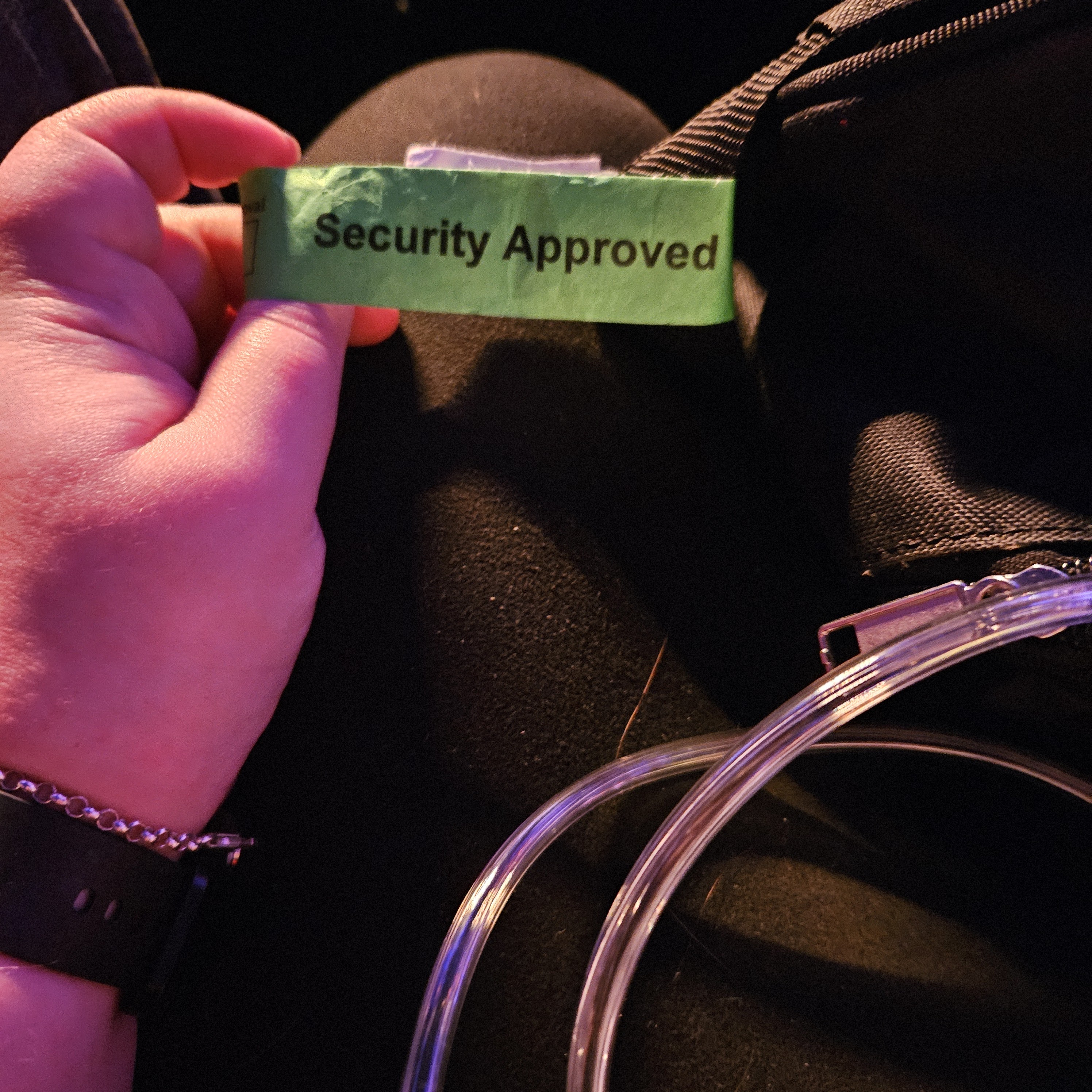
Tag attached by arena security to show my oxygen tanks were allowed into the main arena

We were taken to the steward who would look after our section of seating, and then the member of staff who found us in the lobby took me to see where my rollator would be stored. They placed it beside one of the coffee bars, under the tiered seating and hidden by a curtain. This meant it was kept an eye on all night, and I could relax knowing it wouldn’t be tampered with and that I would be able to get to it easily if I needed to during the gig or in case of an emergency. She helped me up the small amount of steps towards my seat, and told me that if I wanted to move around when the lights were out to wait for her to help me down the steps so that I didn’t trip.

We then found our seats and settled in. After a while the arena started filling in, and I decided to go to the bathroom before the gig started. I had already been shown where the accessible bathrooms were, and how to get to them. On my way back I had a chat to the steward, Nicola, to ask if there was anything we could do if people were stood infront of us for a long time during the gig. At first there was a little confusion, as she thought I meant the people in the standing area! When I explained that I meant the people who were supposed to be sat down, she said that if they wanted to stand they would be directed to the standing area. I understand that people want to dance at gigs, and wouldn’t have minded people standing for a song or two, but I heard people saying they planned to stand for the entire gig, and this was concerning as I knew I wouldn’t be able to stand, and there were other disabled people around us who would have had the same issue.

A photo of the script as seen from our seats

Throughout the gig, the staff were really good at enforcing the no standing/go to the floor rules, and consistently reminded people that they needed to sit down or go to the standing area, as there were people in the section that couldnt stand. In fairness to the people who were infront of me, they did move to the floor, and were very understanding, even asking their children not to stand infront of me or block my view.

At the end of the gig, I was taken to my rollator, and we were asked about our experience. I waited on my rollator while my partner got me my merch, and I refilled the water bottle for the walk back to the apartment. We asked a steward how to get back to the ramp, and he offered to walk with us, but once he gave us directions we felt pretty confident so we made our way towards the ramped exit. As we were approaching another steward saw us and walked us the rest of the way, making sure we had clear passage to the ramp and exit.

We had an amazing time at the gig, and we are so glad we went. For a while it felt like something we would never do again, partly because of Covid, but also because my mobility and general health have deteriorated so much in the past 4 years. We didn’t know if my cluster headaches would cope with the strobe lighting, or if my hips would allow me to sit on the seating.

I was very fortunate and although I did get a small niggle in my head I was able to keep it at bay with a small amount of Oxygen, and the strobe lighting really didn’t impact me the way we thought they would.

I am very grateful we got this experience, and I am so excited to know that this is something I can still enjoy.

My experience attending a gig at Cardiff’s Utilita Arena part one – preperation.

I have always loved music, I grew up surrounded by it, I was very fortunate to go to schools that heavily encouraged it and have parents who introduced me to so much great music while encouraging me to pursue my own interests in it. Before the pandemic, I attended quite a few gigs with my fiancé, including George Ezra, BBC big weekend Swansea, Tom Walker and multiple gigs with The Script. During the hight of the pandemic we started to wonder if I would ever get to go to a gig again. However, on Monday 18 November 2024 I finally got back to something I deeply love – singing my heart out with my fiancé by my side, surrounded by people who are united by music at a gig performed by my favourite band. I am going to share my experience from booking the gig to attending and everything in between.

For those that aren’t aware, during the covid Pandemic I entered shielding. This was the government programme in the UK aimed at trying to protect those deemed most vulnerable to severe complications if they contracted Covid, especially before they knew wha treatments were effective. While official shielding actually ended quite a while ago, my doctors have advised I continue to take a lot of precautions and until June 2023 we still weren’t really having people in the house, and I wasn’t going out very much at all, but something happened in my personal life that forced me out of shielding, and I started to think about how to balance keeping safe with having some sort of quality of life.

The last thing I actually did before entering shielding was attend a gig by The Script in Cardiff, so when they announced their new album, Satellites, earlier this year with an arena tour to go with it, I strongly felt like it would be the perfect way to get my feet wet and try getting back into society. We were nervous though, and we knew that a lot had changed since the last gig we attended. We knew I wouldn’t be able to stand for the gig this time, and that I would have to take my rollator and portable oxygen plus my sumatriptan injections.

Before we booked the tickets, I emailed the Utilita arena to ask if bringing in these items would be OK, and to see if I would be OK to book in the general seated area if the access tickets were sold out. They came back to me really quickly and told me as long as I had prescriptions for medicines and my oxygen it would be fine, and they let me know that I could book anywhere in the venue I wanted, just to let them know where I would be so they could make sure I was looked after.

The morning of the ticket sale came, and the accessible tickets ran out pretty quickly, so we booked some standard seated tickets, and I emailed the venue to let them know. They advised me that they would be able to store the rollator for me so it wasn’t left unattended or creating a hazard for anyone. They also told me that there would be a medical room I could use if I needed to inject my sumatriptan during the gig, and that if I needed a private room at all they would be able to organise this for me.

Once the basics were sorted out, I emailed to let them know I would be able to get all the paperwork they needed, and asked them if I would be allowed to take in a bottle or a drink. Previously we had stood at the gigs in this location, and they usually handed out water, particularly if you were near the front, but I was aware that this may not be the case in the seated area, as it isn’t as hot there. I let them know about my coeliac disease and how I may not be able to consume the drinks sold in the venue, as there may be contamination risks, or they may contain barley. Again they responded really quickly, and they let me know that I could take in an empty plastic bottle for water which I could fill for free at their drinking water fountain, and that I could even take in a small amount of gluten free snacks.

As we got closer to the gig, I made sure I contacted my respiratory nurse for a copy of my oxygen prescription. I also contacted the oxygen delivery company to let them know I would be staying away from home for a few days incase I needed to get an emergency delivery while there. I also ordered something called a tube clip. They are usually used by people with feeding tubes to hold the tubing out of the way and support it so that if it gets tugged it doesn’t tug on where the tube enters the body. Having seen how they worked, I ordered one from Miana at Tubie Express, and planned to use it to hold my oxygen tubing out of the way while at the gig, so that it would move with me and not be a trip hazard for anyone else. I did end up using it, and it worked perfectly.

About a month before the gig, I found an accessible taxi company from south Wales who had a wheelchair accessible taxi available, and booked with them. This meant we knew I would be able to take my rollator or even my wheelchair, and we wouldn’t have to stress about taxis or buses.

We travelled to Cardiff two days before the gig. I made sure I had my medications in their original boxes with the pharmacy labels visible, I also made sure that I packed my loop earplugs incase I needed them in the gig, and my sun glasses incase the strobe lighting caused an issue. I double checked that the oxygen company had the full address, and I made sure that I rested appropriately before the trip.

Using the accessible taxi definitely made a huge difference, and made this trip much less painful and stressful so it is definitely something I would recommend if you have the option of doing it.

Health update – Gallstones

Around 6 -7 weeks ago I started experiencing worsening stomach pain that didn’t feel like my usual crohns related stomach pain. After a week of the pain getting slowly worse and very nearly giving in and going to A&E I decided to book an urgent appointment with a GP.

The GP was really great, he was really thorough, listened attentively to all of my concerns and my long history before performing an examination and deciding it seemed to be a gall bladder or liver issue. Due to the extreme nature of my pain and the fact that I had a rapid heart rate and a slight temperature, he decided to send me into the surgical admission unit at a big hospital.

They did some bloods and checked me over and agreed that it was very likely to be gallstones and sent me home with a referal for an urgent ultrasound. I got the ultrasound a few days later and a nurse called me that afternoon to tell me I have a nice big stone and need surgery to remove It along with the gall bladder. I was told I would see a surgeon within a couple of weeks to discuss surgery and decide the best approach for me.

Unfortunately a couple of weeks later I experienced really severe pain and it was decided by me and my family that I needed to try and go to the hospital. We attended A&E and after a very long night I was put on the list for the surgeons to review me. They told me that I definitely need my gallbladder removed but that because of my other health conditions they didn’t feel that it would be possible to do the surgery during that admission. The plan was supposed to be that I would remain there for a couple of days and get good pain management from the pain team, and that I would only leave once the pain was under control, but unfortunately this was over ridden and I was sent home as soon as the pain team had spoken to me, but under the impression that my appointment had been speed up and I wouldn’t have to wait much longer.

However I still dont have an appointment. I phoned the nurse line yesterday and was told it’s normal, and that although my appointment had been expedited, they hadn’t actually made the appointment yet. I was advised to wait another week and then call the appointment booking team and ask them. I was also told that I am not yet on the surgical waiting list, despite being given the impression that I would be on it from the date I was referred to the surgeon as seeing the surgeon is just a formality, and the list is quite long so it was very unlikely I would have been called up for surgery before I was the surgeon in out-patient clinic.

Unfortunately I am still having a hard time with pain. I have been told that most people with gall stones experience intermittent pain and flare ups with breaks in between them but unfortunately my pain is constant and persistent. I am currently on very high levels of prom relief that I have worked out with my GP, but the pain still frequently breaks through those meds. It is having a massive impact on my quality of life, I am unable to sleep more than a few hours at a time without waking up for pain meds, and I am finding even the most basic tasks very difficult. My appetite is all over the place and it is very difficult to juggle the dietary restrictions for the crohns and coeliac along with the suggested changes for gallstones. I am finding though that for me, it doesn’t seem to be high fat foods that are causing the issues, and it seems much more random, I am keeping a food and symptom diary to help keep track.

I have been told several times by GPs and the hospital staff that I should be a priority, so I am hoping that this will be followed through, I will definitely let them know how much this is impacting my quality of life and the rest of my health issues, and point out that I am at a disadvantage to other patients, because most people have the option of going to A&E and having them consider doing the surgery urgently if things get too much whereas it has been made clear this is not an option for me, also the size of my stone means I am in severe and constant pain and needing a lot more pain meds than I am comfortable taking long term.

Its never nice getting a new diagnosis and finding out you need surgery again, but looking back over the last year or so a lot of my symptoms and the things I have been struggling with could be explained by the gallstones. If this is the case, I may feel a significant improvement in my overall wellbeing after my surgery and although I am trying not to get my hopes uo too high, I can’t deny its a little exciting to think some of my symptoms might actually have a fix. Until then I am just resting as much as I can and using all the tools I can to look after my mental well being as much as possible to.

The burden of proving you’re “Disabled enough”

Something I don’t think people who aren’t chronically ill/disabled understand is the constant burden of having to prove you are sick or disabled enough for the various types of help that you need to be able to exist in society.

Many people assume that if you are sick or disabled, you will get the help you need without too much fanfare, I have even heard people say that if you don’t get a particular type of help, that must mean you aren’t sick/disabled enough, as they assume that anyone who qualifies will get it automatically, but this simply isn’t the case.

There are so many types of help disabled people have to apply for, and for all of them the burden is on us to prove we are “disabled enough” to qualify, and if for any reason the people in charge of the scheme or benefit don’t agree with you, you just don’t get awarded.

Just recently I have experienced this. I won’t name the company, but I have been a holder of a document that helps you access facilities when you book or attend things such as gigs, festivals, amusement parks and more. It is well recognised and a lot of companies trust it, so a lot of places will as for it to prove you are eligible for the help you are asking for.

I have been using this document for six years. When you apply, you tell them what help you need, and they look at the application and your evidence, and decide if they agree. They then put symbols on the document to let venues etc know what help you require.

The first time I applied, I got all the symbols I asked for, without any issues. When the card needed renewing, I sent the same evidence again, as it was still in date, but this time they said they couldn’t issue one of the symbols, which was to show that I needed a carer. I contacted them and they told me their policies had changed, and that I needed a more specific letter proving I needed help while out that was more than a friend would normally provide.

I got a letter from my GP stating that I need help with injections, and that I need help safely getting out in emergencies, communicating and sometimes with other medicines and other miscellaneous tasks that enable me to go out safely. The company agreed that this was a higher need than they would expect a friend to manage, and gave me the carer symbol.

This month, it needed renewing again. I sent off the documents, including the letter stating I need significant help while out, including needing someone to inject me if I am unable to do it. I also added newer documents from my neurologist that showed my diagnoses, and a copy of my oxygen prescription. Again they came back and said they could not issue the carer symbol. I have emailed back and I am waiting for a response.

Keep in mind the evidence I gave is the evidence they specifically asked me for. There is a charge for the document, and, if I was to go back to my GP and get another statement of fact letter then I would be charged for that too. That isn’t something I can afford every time the document needs to be renewed.

Without the carer symbol, I have to pay for someone to come with me to anything I do, I no longer go out alone unless there is no choice (i.e when I go to hospital via ambulance transport). I cannot go to a gig, or the cinema, or a museum, or a normal doctors appointment by myself any more. The last time I tried it ended in extreme pain and being unable to cope. This places yet another financial and emotional burden on me. If I can’t afford to pay for someone to come with me, then I can’t afford to go at all.

I totally understand that things like this document, and benefits and blue badges etc need to be protected. If they are given to anyone who asks for one, they will loose credibility, but, as a disabled person, it is very hard to keep proving yourself, especially if the goal posts keep being moved. Each time I have applied to renew this document they have changed the requirements for evidence, making it impossible to keep up with and forcing me to pay for more documents I will probably only use once.

This isn’t an isolated incident, so many companies and government schemes do this. They say it’s to make sure the right people get help, and I am sure thats part of it, but the reality is that people who need the help are also being shut out. I cannot afford to keep paying for more evidence, so I am shut out of so many things that are supposed to help me.

Then there’s the emotional toll of constantly feeling like you aren’t “disabled enough” every time you get turned down. It makes you feel like you don’t deserve the support, like there’s some sort of competition and you lost, and this is a constant part of the lives of disabled people.

Another thing people don’t realise is that this doesn’t just happen to people with temporary illnesses or disabilities. I have multiple permanent illnesses and even though I have provided evidence of this I am still expected to show new evidence whenever these companies decide. Again, I understand the need to make sure systems aren’t being taken advantage of, and there are some illnesses that get better, or where treatment will minimise symptoms and function can be improved, but if you have been told by your doctors that this is not possible for you, then this should be taken into account when applying for support.

There are many disabled people in financial or social hardship because they were turned down for help that they desperately need, and that needs to be addressed. We need a much better balance between safe guarding these facilities for those that need them, while also making sure that it doesn’t become inaccessible for those who truly need it. The stress and emotional turmoil of these systems has caused me to seriously question applying for many of them and I know I am not alone in this.

Diagnosis story – Coeliac Disease

Coeliac disease is an auto-immune condition where the immune system reacts to gluten in the foods we eat, causing inflammation in the digestive tract. There is no known cure, and the main treatment is a strict gluten free diet.

I was diagnosed with Coeliac disease after a couple of years of vague symptoms, this is my diagnosis story.

When I was around 12 years old, I began suffering from pain in my shoulders. I regularly suffered with pain in various joints, especially my wrists, and we usually thought I had just injured myself. The shoulder pain was different though, and wouldn’t ease up.

We went to my GP, who did an examination and gave me some pain killers and anti-inflammatory medications, telling us to go back if symptoms didn’t improve.

While the pain killers helped, my symptoms didn’t go away, so we returned and some blood tests were ordered. They found out I was anaemic, and I was given iron tablets. I was also sent for xrays which showed some form of abnormality, but we weren’t told what the abnormality was.

I was eventually sent for physio, and for a while my symptoms did improve a little, but unfortunately this didn’t last. We went back to the doctors and I was anaemic again. This time a locum doctor decided to try and figure out why I was so anaemic, especially after multiple courses of iron supplements.

She ran a blood test for TTG, which is the antibody made by the body when you have coeliac disease. This is what attacks the enzyme in the intestines, causing damage. My levels came back so high that the lab thought it was an error, and we had to repeat the test. When it came back just as high again, I was referred to a paediatric gastroenterologist.

When I met the GI, he was very surprised that I was relatively healthy, he said that my levels of TTG were so high, he expected me to be extremely sick. My only symptoms were the shoulder pain, anaemia and low energy, which we had put down to the anaemia. It turns out my TTG levels were so high the lab actually stopped counting at 250. I was sent for an upper endoscopy with biopsies to confirm the diagnosis.

Strangely, the endoscopy and the biopsies came back normal, which no one was expecting. The GI speculated that possibly they had just biopsied the wrong spot, or, more unlikely, there had been some sort of lab error.

At the time I was tested it was usual to go off the biopsy results, but my blood levels were so extraordinarily high that they decided to go ahead and treat me for coeliac anyway and I started a complete gluten free diet.

I have now been on a gluten free diet longer than I was on a gluten containing one. We now know for absolute certain I have coeliac, as my TTG levels went down drastically once I stopped eating gluten, and I now get severe symptoms if I accidentally consume even a minute level of gluten. It also turned out that I did have more symptoms than we thought, I was just so used to feeling crummy I thought it was normal. Once I switched to the GF diet I had much more energy, a better appetite, I didn’t feel constantly sick in the morning and I was generally just much happier.

If I accidentally get glutened now, I get severe stomach pain, flushing of the face, swelling of the lips, extreme nausea and vomitting, headaches and general muscle and body aches. While at the time of diagnosis my symptoms weren’t that noticeable, I can only imagine how bad they would have got if I wasn’t diagnosed when I was.

If you think you might have coeliac disease or of the symptoms, please speak to your doctor.

What are dynamic disabilities?

If you spend a lot of time on the internet and particularly looking at chronic illness and disability social media, you may have seen the term “dynamic disability”.

Dynamic disability is a relatively new term used to describe disabilities that change from month to month, week to week, day to day or even hour to hour. It covers a wide range of disabilities and illnesses with fluctuating and changing symptoms.

Despite what many people may believe, there aren’t actually many disabilities or illnesses that remain the same 100% of the time. The vast majority of people with disabilities will experience changes in their symptoms and therefore their capabilities on a fairly regular basis.

This is why someone with a disability may be able to do an activity on a particular day, but be unable to do the same activity the next day or the next week.

For many of us, what we can do depends on how fatigued we are, how much pain we are in, how our medications are working, how much sleep we have had, if we have been able to eat or drink enough , environmental factors such as the temperature and so many other variables. We know it can be confusing if you see us doing an activity with a friend or other loved one, and then a couple of days later say we can’t do the same activity with you. This is not personal, and we aren’t avoiding you. The reality is our symptoms can genuinely change day by day, and we have no control over it.

Dynamic disabilities and fluctuating symptoms are also why you might see us using different mobility aids from day to day or even hour to hour. Depending on my symptoms, where I am going, my mode of transport, how much other equipment I have (such as my oxygen tanks) and how much help from others I have available, I will either use a wheelchair, a rollator, crutches or, (rarely ) a folding walking stick. When out with my rollator or wheelchair, I will have my folded walking stick in a bag, so that if I need to walk a short distance because my wheelchair or rollator won’t fit somewhere, I have support. This has resulted in a lot of very confused looks when I have come out of a toilet with my walking stick and sat in my wheelchair.

One of the best things you can do for someone with dynamic disabilities is believe them if they say they can’t do something on a certain day, and be flexible with your plans. If you’ve arranged to go to the cinema and they don’t feel up to it, ask them if they would like it if you came over and did a movie day instead or if you’re supposed to go out to eat, offer to cook or pick up take out. Sometimes they might feel so sick that even hanging out at home feels like too much, but it lets them know you’re there for them in whatever way they need you to, and they might welcome the company. I definitely wish some of the people in my life would be more willing to just hang out with me at home rather than going out all the time, as I don’t often feel up to big nights (or even days) out, but still want to spend time with the people I love.

Alternatives to “Get well soon ” for people with chronic illnesses and disabilities

When we hear that someone is unwell, our first instinct is to wish them well, and hope that they recover quickly. This means a common response to someone saying they aren’t feeling too good is “get well soon” or ” I wish you a speedy recovery”. For most common ailments like the flu or a “normal” headache, this is a totally appropriate and often appreciated response.

This changes when the illness is chronic, and especially when the illness is known to be permanent and incurable. When you know that your illness will not get better, it can be jarring to hear “get well soon”, especially from people who you know well and have explained your situation to, but, its such an ingrained response, it can be very hard for people to know what else to say. Not responding or not wishing someone well can seem cold and uninterested, we want to show someone we care about them and want them to be OK, but sometimes the harsh reality is that they aren’t going to be ok for a very long time, and sometimes they won’t ever be truly OK again.

In this situation it is so tough to know what to say, so I would like to share my thoughts on what I would like people to say/ what I think would be helpful. As always, these are my thoughts and my thoughts alone, and do not apply to everyone, I speak for myself and myself only, not the whole chronic illness community, so be open to hearing other suggestions and/or opinions from the people in your life.

Suggestion one – I am sorry you are going through this, if you ever need to talk about what it’s like for you to deal with this, I will listen.

This lets someone know that you are aware that what they are going through is hard, and offers them a safe space. Very often people with chronic illnesses have to mask and pretend to be ok when really they aren’t, offering someone the chance to have an open conversation about what they are going through, with no masking and no worrying about being judged can be a huge gift. Only offer this if you can follow through, and remember that this is an opportunity they probably don’t get very often, so make sure it remains a safe space.

Suggestion two – I know that I cannot take away your illnesses, but is there anything I can do to make your burden lighter?

This shows you are aware that you cannot fix the person or their situation, but that you are willing to try and make it easier to bare. Asking what you can do allows the person to pick the thing they feel they need the most or are most comfortable allowing someone else to deal with. This could be something as simple as cooking them a meal, putting the hoover around for them, picking up a medicine from the pharmacy or picking up a child from nursery or school. Sometimes when your mind is overwhelmed with big things, the little things become a huge burden, and if someone can ease that burden it makes things feel so much more manageable.

Suggestion three – if they are cancelling an activity because they are too sick or there is a risk of the activity making them sicker, ask about an alternative rather than just not inviting them next time.

This is something I really appreciate when people do for me. Its one thing to miss an event because you have the flu, where you know you will get better and be able to join in next time, but when you are unable to join in because of chronic illnesses, you are very aware that you might not be able to join in for weeks, months or years at a time. There might be some activities you will never actually be able to do. I have had so many people give up on me, including people I thought understood, because I kept having to say no to specific activities, but everyone else wanted to keep doing them. Eventually they just stopped asking me, or making any attempt to make things accessible to me. People often think that if they can’t see why something is inaccessible, or why I am too sick to do something, then I am just making excuses. I often get told “get well soon and maybe next time you can join in”. I would absolutely adore it if sometimes they said “I’m sorry you’re feeling so sick, what if we come over and have a PJ day and watch movies all day” or ” I know eating is challenging for you, what if we did something crafty instead”. There are many ways hang outs can be made more accessible for your sick loved ones, it takes a little creativity sometimes, but it can be done. I am not suggesting that every hang out needs to be tailored to that person, but even one in every 3 or 4 hang outs being something they can join in with is so much more welcoming. Sometimes they may feel so sick that they cannot think of anything they feel up to doing, but thats ok, the fact you ask them will mean a great deal to them.

Suggestion 4 – I know this is really hard for you, and I know I can’t make it all better, but I have your back and you’re not alone

This is so powerful. Just knowing that someone has your back, that they understand things are hard and it’s not going to scare them away or make them think differently of you is so, so powerful.

Suggestion 5 – Do you need support to access medical help?

While there isn’t always something a doctor can do for chronic illnesses, if someone is having an acute flare of their condition and seems like they may be struggling beyond what is considered “normal” for that person, asking them if they need support to access medical care can be really helpful, provided you are respectful of the answer. I have had times where if I had access to better transport, I would book a GP appointment to get checked out , but because I am stuck with buses, I will wait things out and hope it doesn’t escalate far more often than I should. For me, going to the doctors and especially going to a hospital is something I do when I have no other choice, and the alternative is going to A&E because its heading towards and emergency. If someone was willing to help me get to the doctors, I would book more regular appointments to get check ups and discuss anything concerning me before it became an urgent issue. On the other hand, some people will ask me about going to the doctors when I am just experiencing normal aspects of my conditions and there is nothing a doctor will be able to do that I can’t do myself. I never mind being asked, but some people get really pushy, and this can be distressing.

Suggestion 6 – Is there anything I can get you to ease your symptoms?

This one I personally like. People are often quite quick to say to me “sorry there’s nothing I can do for you”, but they often haven’t actually asked me or thought about the types of things that they usually see me do when I am in pain. Some people though are very good at it, for example, I use a heat pad almost all the time to ease my pain, so , if I am in pain and I don’t have my heat pad, my fiancé will go get it or ask if I want it. My mother will ask me if I want my heat pad or a hot water bottle. This is a small thing, but it really helps. Unless you know someone very well or know what they need for specific symptoms its hard to anticipate needs like this, but what you can do is ask them if there is anything you can get to ease symptoms. These may include getting a heat pad, ice packs, pain medications, ginger tea for nausea, a blanket, a glass of water or something to eat, or a comfort item like a favourite teddy or comfy hoodie. These small things make people feel seen, and show that you are actively trying to ease their discomfort and care for them.

The biggest thing I would say with any of these is be consistent. Too many people with chronic illnesses feel like they are forgotten about after the first few months of illness. When you first get sick, you are often surrounded by people who want to help. There are visits and calls, gifts and meals, accommodations are made and everyone checks in to see how you are and what you need. After a while though, people go back to their lives, assuming that you are either better or “used” to the condition by now. The offers of help get further apart, people stop checking in, and instead of making accommodations people tell you to stop being lazy and to stop making everything about you. People actually get frustrated and even annoyed that you aren’t suddenly all better. So, the biggest gift people can give me is continuing to check in months and years after diagnosis, continue to offer help, to hang out, to show genuine interest in my well being and not make me feel like a burden or an inconvenience.

How to ask about someone’s chronic illnesses/disabilities

Humans are naturally curious beings so when we come across something we aren’t familiar with its only natural we want to ask questions and learn more. The problem however is that sometimes when dealing with sensitive topics questions can come across as nosey, insensitive or even down right rude.

As someone with a long history of chronic illness I have experienced many years of questions and curiosities. For the most part people mean no harm, but when you’re dealing with this on a regular basis it can become overwhelming. In this post I’m hoping to help navigate asking questions about chronic illnesses and disabilities and what not to ask. Pease remember I am speaking from my own personal experiences and preferences so always remember other people with chronic illnesses/disabilities may have different opinions.

* Always check its ok to ask about someone’s condition first.

I always prefer it when someone asks me if its ok for them to ask a question/questions before they begin asking. If someone just blurts out a question it can feel insensitive and puts me on the spot whereas if they ask permission first it gives me the option to say no, or to put boundaries in place for my own comfort.

* Ask the person if there are any subjects that are off limits

As we are all individuals, we will all have different levels of comfort when answering questions about our illnesses or disabilities. These comfort levels may even change day to day so it’s always really helpful if someone asks what my boundaries are and respects them.

* Don’t ask a question if you’re not prepared to deal with the answer.

I have lost count of the amount of times someone has asked me a question about my situation and then been totally unable to deal with the answer. This leaves me feeling misunderstood and alone. If you can’t deal with the worst case scenario answer then just keep the question to yourself.

* Don’t ask about prognosis without express permission.

Prognosis can be a really difficult topic. While its natural to want to know what someone’s future may look like, its a very difficult subject to talk about and there’s a chance the person doesn’t even have a full answer. If you absolutely must ask, always give a warning shot and wait for permission. Do not approach a stranger with this question.

* Don’t respond with unsolicited advice

Due to the fact I am so open about my conditions I often get people asking me more information about my illnesses including treatments and symptoms. The questions themselves don’t usually bother me, but people often can’t resist giving me unsolicited advice when I answer. This actually puts me off answering questions in the first place and can feel as though people think I’m not taking care of myself.

* Respect boundaries no matter when they are introduced

Boundaries are super important when dealing with sensitive topics. I often find that if I answer one question people think I will answer all questions even if they’re really personal or if its the middle of the night. People often get offended if I say no to answering more questions, especially if they have seen me talk about my illness on a social media profile. The person with the illness gets to decide how much they say, when they say it and who they say it to. It is entirely their right to change their mind about sharing, or to only want to share at certain times.

* Don’t make it about you

Although hearing about someone’s illnesses or situation can be difficult its important that you don’t make the situation about you by instantly talking about how it makes you feel or becoming excessively upset. If you have an established relationship with the person and/or its someone you are close to then it may be appropriate to talk about how the situation impacts you when the sufferer is ready to do that or once they have finished talking about their own feelings. If its someone you don’t know or you’re only having a one off conversation then its better to attempt to control your response and maybe talk about your feelings with someone else who isn’t impacted by the situation.

*Only offer help if you can follow through

It’s natural to want to help someone who is suffering, but sometimes we make offers and promises we can’t keep which can lead to tricky situations. If you’re going to offer help, please make sure it’s something that you can stick to. If you can’t offer practical help then a listening ear is often just as valuable. If you can give practical help, it’s usually best to ask the person for examples of the type of help they may need or want, rather than making assumptions or doing things without checking first.

*Don’t suddenly change the subject

If you have asked someone about their illnesses or someone is telling you about their situation, do not just suddenly change the subject. I have lost count of the amount of times someone has abruptly changed the subject when I am trying to open up to them. When someone is trying to talk about a hard situation it can make them feel extremely vulnerable and when they are cut off or the subject is changed mid conversation it can make them feel dismissed, unimportant and as though you just aren’t interested in what they have to say.

Gift ideas for chronic illness fighters

Gift giving can be tricky for anyone but when you’re buying for someone with a chronic illness it can be harder to know what they might find useful.

1 – Heat pads/ heated blanket

If the person you are buying for has any sort of pain linked to their condition or struggles with being cold, a heat pad or a heated blanket can be a really great way for them to ease some of the pain and protect themselves from the cold. Electric heat pads are even better because you don’t have to keep going to the microwave or boil the kettle to get heat, you just plug them in and off you go. Many of them have variable heat settings and safety cut offs to prevent over heating or burning.

2 – Comfy clothing

For many people with chronic illnesses, especially chronic pain or sensory issues, comfy clothing is such a blessing. This could be something small like some comfy/fluffy socks that don’t have cuffs or a cosy hoodie to wrap up warm with, anything that you’ve seen your loved one wearing that you could find a comfy version of. Clothing can actually be painful for some people with chronic illnesses and anything that makes it better is so appreciated, it’s also really comforting when you can just snuggle down in something comfortable and just relax.

3 – Fun mobility aids

If your loved one uses mobility aids then fun or luxury versions of those can be great gifts. I would always recommend asking before buying a mobility aid because preferences are so personal, but one way of doing it might be to take them shopping to get them a gift card for somewhere that sells mobility aids so they can choose what they think will work best for their needs.

4 – Skin care

Many chronic illnesses come hand in hand with chapped lips, itchy or irritated skin and dryness, once you have made sure your loved one doesn’t have any allergies, high quality and luxurious skin and lip care can be really nice as a gift. We get so busy taking care of our medical needs that we often forget to look after our other needs so getting something skin care related can encourage us to do other forms of self care and really look after ourselves.

5 – Cosy blankets

Similar to the comfy clothing, having a comfy blanket to snuggle up under when you’re feeling really unwell can be really comforting.

6 – Streaming service subscriptions/ gift cards

Being unwell a lot means lots of time in bed/on the couch with not very much to do. Having access to a good streaming service for movies/ tv shows can be really helpful. It helps to keep us occupied while promoting rest and relaxation. If your friend or loved one isn’t a bug movie lover then you could switch out a movie subscription for a music or audio book streaming service .

7 – Books

Another thing that comes with chronic illnesses is a lot of time waiting around in hospitals and doctors offices. If your friend or loved one is a book worm then a good book to dig into while they’re waiting around could be a great gift.

8 – Snacks

Easy to prepare and eat snacks that cater to any allergies your loved one may have are a great gift idea. One of the things I struggle with is having the energy to prepare food, usually by the time I have made my snack or meal, I don’t have any energy remaining to be able to actually enjoy eating. If I could have a never ending supply of easy to eat, low preparation snacks it would definitely encourage me to eat on those low motivation days.

9 – Fancy water cups/ bottles

Hydration is really important for everyone and many chronic illnesses actually make maintaining hydration more difficult. Many of us loose extra water due to symptoms such as vomiting or diarrhoea, or we deal with electrolyte imbalances due to the impact of our underlying conditions, so its really important we drink enough to keep us safe. Having an easy to grab and use water/drinks bottle to keep with us and keep topped up can really help with this, and who doesn’t love a swanky new drinks container?

10 – Chore coupons

For many with chronic illnesses basic chores become more difficult and sometimes even impossible. Chore coupons are a great way of offering help on the other persons terms, it allows them to choose the type of help they need on a particular day and they can ask for it in a non pressured way. It doesn’t have to be anything big, it could be something as simple as doing the dishes or walking the dog, or you could push the boat out and offer a deep clean if this is something you think they would both need and feel ok about. Our time is the most precious gift we can give someone and it will always be appreciated.

10 Things I wish everyone knew about life with chronic illnesses

There are many aspects of chronic illnesses that you will only truly understand if you actually deal with one yourself . This can make it difficult for those of us dealing with these illnesses to integrate into society and maintain jobs, social lives, intimate relationships and more. Here are 10 things I wish everyone knew about living with chronic illnesses.

1 – There’s no time off.

When you have a chronic illness its a 24/7 365 day job. There’s no putting in holiday leave, no baby sitters or task sharing and there are no allowances for holidays or special events. We have to deal with our illnesses where-ever we are, no matter what we’re doing or who we are with. Even at night, when the world is sound asleep we are often up late taking meds, managing pain and other symptoms, trying to maintain hydration, adjusting positions and keeping our temperature just right. It’s exhausting and its lonely, no matter how good your support system is it is impossible to fully communicate how difficult it is to live with these things 24/7. Burn out is common among people with long histories of chronic illnesses and its really not surprising when you think about it, so give us a little grace if we’re a little cranky or we slip with our household duties, we’re working a full job just existing.

2 – Doctors don’t know everything

So many times over the years I have heard “why didn’t you go to the doctor” or “you should get a different doctor, you should be better by now” or words to that effect. Here’s a ground breaking fact – doctor’s don’t know everything! That’s right! Doctors are humans just like the rest of us and it is impossible for them to have answers for every problem and every ailment. There is a lot about the human body that we still don’t understand yet which is complicated by the fact that they can’t ethically examine the human body while people are alive if there’s a chance it will cause harm. As a result, there are a lot of things doctors can’t cure, they can’t always just write a prescription and make everything better. The best doctors I have had are the ones that acknowledge this, they know they don’t have all the answers and they don’t make promises that they know they cannot keep, instead they will talk to me about the options we do have and why they think each option is good or bad. They make sure that I understand why they can’t make everything better, and work with me to ensure the best quality of life possible while trying to figure out a long term plan.

3 – Sleep doesn’t fix fatigue

We’ve all been tired, whether we’ve pulled an all nighter getting college work done, stayed up late chatting to a new beau or lost sleep to a loud neighbourhood party we all know what sleep depravation feels like. We also know that usually the answer is a good nap followed by a few really good night’s sleep. Fatigue is different, fatigue is feeling like the simplest tasks are 100 times more difficult, something as simple as going upstairs becomes a mammoth task, walking for 5 minutes feels like walking a marathon. For many people with chronic illnesses fatigue is a well known friend, just existing with a chronic illness burns more energy than existing in a healthy body, simple tasks take extra effort and we often have the double whammy of disrupted sleep due to medication or symptoms. For us, a nap or a few good nights sleep won’t help, we could sleep for a week straight and still wake up feeling exhausted. What can help is pacing, breaking tasks up into smaller, more manageable chunks, only doing a certain amount in a day, taking regular breaks and staying on top of food and drink. If you want to help someone with fatigue, taking some tasks off their plate may be a good way to go, you could offer to cook them a meal, take the rubbish out, watch their kids or even offer a relaxing activity such as a movie night so they get a chance to hang out and rest while feeling included. What really helps is asking what the person needs and doing it without judgement.

4 – Unsolicited advice isn’t helpful

Whenever someone is sick and suffering it is totally natural to want to help them, to want to fix things for them and make their lives easier. Any good person hates to see the suffering of anyone else, especially people they care about and this drives them to give anything they can, including advice. Unfortunately this advice isn’t always wanted and in some cases can be distressing and even dangerous. If someone has been dealing with a chronic illness for any length of time there is a good chance that they have already tried every reasonable step to help with both the underlying illness and the symptoms. Dealing with these illnesses is exhausting and isolating, so imagine what it’s like when everyone you talk to has an opinion on what they’re doing and how they should be managing things. If you really, really want to give advice, ask the person if they would like to hear your thoughts first, for example if you’ve heard of something that might help nausea, you could say “I saw a new way of dealing with nausea the other day, would you like to hear about it?”. If they say no, then listen! Don’t continue to push your advice if they don’t want it. Just as importantly, if they say that something won’t work for them or that they already know what to do, then please just believe them. They aren’t saying it to be difficult and it’s not that they don’t trust you or don’t want to get better, they just know their body and their situation better than you do and have a good idea of what will and wont help.

5 – Rejecting an offer of help isn’t personal

It’s absolutely natural to want to help someone who is struggling but sometimes there isn’t anything you can do that will actually help the situation. There are many reasons why someone may say no to an offer of help, they may already know that there isn’t actually anything that will help in that moment, for example they may already have all the help that they need, or they may need help that is of a more personal nature than they feel comfortable asking you for. Over the years I have had people react very negatively if I have turned down an offer of help and people take it extremely personally, but it’s never ever intended that way. If you really want to help, asking the person what they really need is a good start, if there’s nothing they need, then you could ask if there’s anything they *want* to do that they wouldn’t normally ask for like a fun trip or yummy food that isn’t just the basics. If this still isn’t needed/wanted at that time, you can let them know that if anything comes up then you will be willing to help even if time has passed.

6 – Not all illnesses/disabilities are visible

This is something I really wish more people would understand. There are many disabilities and illnesses that are not visible on the outside. For many people with chronic illnesses it’s impossible to tell just how sick they are from their appearance. Many times I have had people tell my I don’t look sick or even that I “look better” while I was actually at my sickest. Even during months of endless hospital stays, being unable to eat without being sick, constant pain and exhaustion I had people tell me how well I look. I have been judged so many times for sitting in a disabled seat on the bus and not getting up for someone older than me because people just assumed I was being lazy, they couldn’t see my immune system destroying my intestine or my joints feeling like they were on fire. Always remember that it’s impossible to truly know what is happening under the surface and someone may be fighting a battle that you know nothing about.

7 – Using a mobility aid does not mean you can ask me private medical information

In the last 6-7 years I have gone from using no mobility aids, to using a folding walking stick, to using crutches, a wheelchair and most recently a rollator. I currently alternate between the later three depending on how bad my symptoms are and what I am going to be doing. For some reason people see these and think it is appropriate to ask me why I am using them. I understand curiosity, and in some contexts I don’t mind answering questions, but when I am minding my own business waiting for the bus, or trying to pay for something in a shop, I would rather not be stared at and quizzed about my medical conditions. I am just trying to get to my appointments or get my shopping like everyone else, and
I would like to do it without being made to feel like some sort of spectacle.

8 – Having fun doesn’t mean we’re better

When you have chronic illnesses and you’re always in pain or feeling rotten, you learn to have fun regardless. Of course there are days where you have no choice but to stay in bed or crash on the sofa, but if we waited to feel well before doing fun things we would waste our whole lives. People with chronic illnesses become very good at having a good time even when feeling horrendous, we learn to pace ourselves, we learn to plan for days for events to allow us to enjoy them, we learn to clear our diaries for days or weeks before and after so we can recover. We also learn to find joy in the smallest things and in moments that most find insignificant. We can make memories sat on the sofa laughing about silly things, or at a music gig , or even in a hospital waiting room. We don’t take any chance at joy for granted.

9 – One good day / week/ month doesn’t mean we’re better

Many chronic illnesses and disabilities fluctuate, it’s quite common for people with a chronic condition to experience periods of less symptoms accompanied by periods of worsening symptoms known as a flare up. For many, the occasional good day/week/month is refreshing and a nice break, but it doesn’t mean we’re all better. For one thing, a good day for us is often still what most would consider bad, we are often still in pain or fatigued etc, and we still have to be careful about what we do so that we don’t make things worse for ourselves when a flare up does start. For another, we know that the good day won’t last forever, we know that the symptoms will be coming back just like before, so even if we get lucky and get a good stretch of time before the other shoe drops, we know that it WILL drop eventually and we have to be constantly prepared.

10 – Pity parties are allowed

We don’t want you to feel sorry for us or pity us, but we also don’t want to feel like we have to be brave and strong all the time. Being constantly sick sucks, it’s hard always being in pain and knowing there isn’t a way to stop it, it’s challenging being reliant on medications, devices and even other people to be able to live. It’s exhausting being on a never ending ride of meds, hospital appointments, phone calls and self advocacy. We are allowed to throw ourselves the occasional pity party and it’s not OK to shame us for it or make us feel like we’re weak or like we should be handling things differently. The key to this is that it’s occasional, and that it’s driven by us and not others. If it starts to be a regular thing and your loved one can’t seem to find any joy in life, it’s a good idea to just offer them some extra support and love. If it’s just occasional and they can still find joy and things to be happy about, then let them be, join in if they would like that, and pity party all night.

So that’s my 10. This is all from my own point of view and experiences of course so other people may feel differently. There are many more things I could add to this list, but these are the ones that come to mind most freely. If you’ve read this far I hope it’s got you thinking a little about life with chronic illnesses. If it’s resonated with you consider sharing it with a friend and think about it the next time you interact with a chronically sick loved one.